Kanya Rashi Letters: Complete Guide to Kanya Rashi Naming Letters
Kanya Rashi Letters: What Are They?
Choosing a baby’s name is an exciting part of preparing for a new arrival. While some parents choose a name simply because they love its sound, others look at its meaning, family traditions, numerology, or astrology.
In Hindu astrology, Rashi-based baby naming is a traditional practice that can help parents narrow down their choices.
Kanya Rashi, also known as Virgo, is the sixth sign in Vedic astrology. It is traditionally ruled by Mercury (Budh) and is associated with qualities such as intelligence, communication, practicality, observation, and analytical thinking.
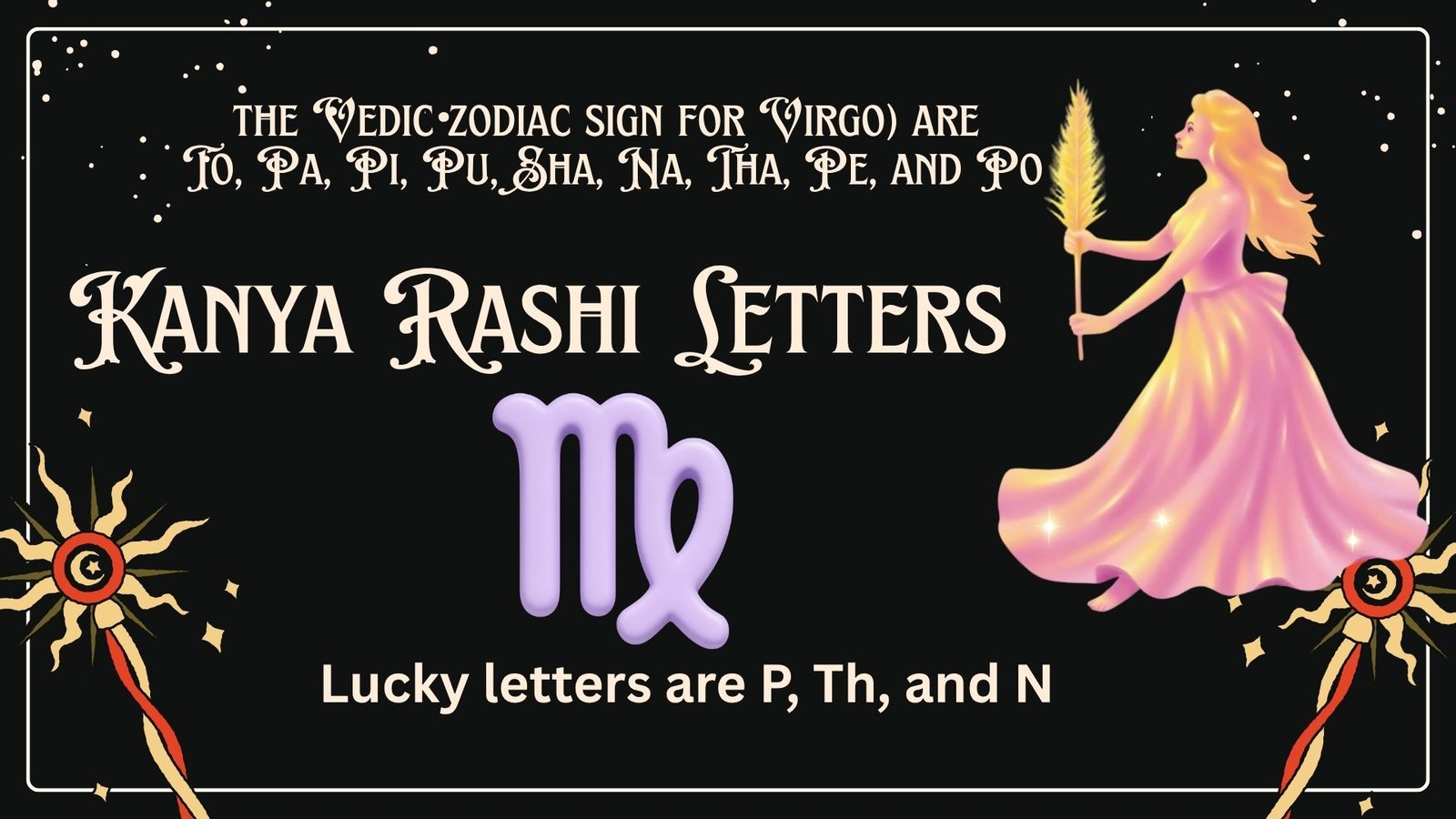
If you are searching for Kanya Rashi letters, the traditional naming sounds associated with this Rashi are:
To, Pa, Pi, Pu, Sha, Na, Tha, Pe, and Po.
These sounds are traditionally connected with the Nakshatras and Padas that fall within Kanya Rashi.
Highlights
| Topic | Details |
| Rashi | Kanya Rashi |
| English Zodiac Sign | Virgo |
| Sanskrit Name | Kanya |
| Ruling Planet | Mercury (Budh) |
| Element | Earth |
| Main Nakshatras | Uttara Phalguni, Hasta, Chitra |
| Kanya Rashi Letters | To, Pa, Pi, Pu, Sha, Na, Tha, Pe, Po |
What Is Kanya Rashi?
Kanya Rashi is the sixth zodiac sign in Vedic astrology and corresponds broadly to Virgo.
The sign is traditionally ruled by Mercury, which is associated with intellect, communication, learning, reasoning, and adaptability.
Kanya Rashi is represented by a maiden.
Traditional astrological interpretations often associate Kanya Rashi with qualities such as practicality, attention to detail, organisation, intelligence, and analytical thinking.
For baby naming, however, knowing only the Rashi does not always give the most specific naming sound. The baby’s Janma Nakshatra and Pada are traditionally considered for a more precise recommendation.
What Are the Kanya Rashi Letters?
The traditional Kanya Rashi naming sounds are:
To, Pa, Pi, Pu, Sha, Na, Tha, Pe, Po
Here is the traditional Nakshatra-wise breakdown:
| Nakshatra | Pada | Naming Sound |
| Uttara Phalguni | 2nd | To |
| Uttara Phalguni | 3rd | Pa |
| Uttara Phalguni | 4th | Pi |
| Hasta | 1st | Pu |
| Hasta | 2nd | Sha |
| Hasta | 3rd | Na |
| Hasta | 4th | Tha |
| Chitra | 1st | Pe |
| Chitra | 2nd | Po |
These sounds are traditionally used as starting syllables when selecting names for babies born under the corresponding Nakshatra Pada.
Kanya Rashi Letters According to Nakshatra
Uttara Phalguni
The second, third, and fourth Padas of Uttara Phalguni fall under Kanya Rashi.
The associated sounds are:
To, Pa, Pi
This gives parents options such as names beginning with Pa and Pi.
Hasta
All four Padas of Hasta fall within Kanya Rashi.
The associated sounds are:
Pu, Sha, Na, Tha
Among these, Sha and Na provide a particularly large collection of familiar Indian names.
Chitra
The first and second Padas of Chitra fall under Kanya Rashi.
The associated sounds are:
Pe, Po
These sounds have fewer commonly used contemporary names, but parents can explore traditional Sanskrit and regional names.
Kanya Rashi Letters Chart
For a quick reference, here is the complete chart:
| Nakshatra | Pada | Kanya Rashi Letter/Sound |
| Uttara Phalguni | 2 | To |
| Uttara Phalguni | 3 | Pa |
| Uttara Phalguni | 4 | Pi |
| Hasta | 1 | Pu |
| Hasta | 2 | Sha |
| Hasta | 3 | Na |
| Hasta | 4 | Tha |
| Chitra | 1 | Pe |
| Chitra | 2 | Po |
In Short
Kanya Rashi letters are:
To, Pa, Pi, Pu, Sha, Na, Tha, Pe, and Po.
Kanya Rashi Letters for Baby Boy Names
The traditional naming sounds remain the same for boys and girls.
Some examples of Kanya Rashi boy names include:
Toshit – Pleased or satisfied
Parth – Arjuna
Parthiv – Earthly or royal
Parikshit – Tested
Pankaj – Lotus
Pavan – Wind or pure
Piyush – Nectar
Punit – Pure
Pushkar – Blue lotus or sacred lake
Shaurya – Bravery
Shashank – Moon
Shashwat – Eternal
Shankar – Lord Shiva
Shlok – Sacred verse
Shrey – Excellence
Naman – Respect
Nandan – Delightful
Nakul – One of the Pandavas
Narayan – Lord Vishnu
Navin – New
Neel – Blue
Nikhil – Complete
Nirav – Quiet
Pranav – Sacred syllable Om
Kanya Rashi Letters for Baby Girl Names
Kanya Rashi naming sounds can also be used for baby girls.
Some examples include:
Toshika – Satisfaction
Pari – Fairy
Pankhuri – Petal
Pavani – Pure
Pihu – Sweet sound
Piyali – A tree
Puja – Worship
Shalini – Modest or graceful
Shanaya – First rays of the sun
Sharanya – One who gives protection
Shreya – Auspicious or excellent
Shruti – Sacred knowledge
Naina – Eyes
Namita – Humble
Nandini – Daughter or delightful
Navya – New or young
Neha – Love or affection
Neelam – Sapphire
Niharika – Dew drops or constellation
Poonam – Full moon
Which Kanya Rashi Letter Has the Most Names?
There is no official rule that one Kanya Rashi letter is luckier or better than another.
However, some sounds are naturally easier to find names for than others.
Pa, Sha, and Na have a large number of familiar Indian names.
For example:
Pa: Parth, Pankaj, Pavan, Palash, Parv
Sha: Shaurya, Shankar, Shashank, Shlok, Shrey
Na: Naman, Nandan, Nakul, Narayan, Navin, Nikhil
The sounds Tha, Pe, and Po have comparatively fewer familiar contemporary names.
If the baby’s Nakshatra specifically points toward one of these sounds, parents may need to explore less common traditional or regional names.
Which Kanya Rashi Letter Is Best?
There is no single best Kanya Rashi letter.
Traditionally, the preferred sound depends on the baby’s Janma Nakshatra and Pada.
For example:
Uttara Phalguni 2nd Pada → To
Uttara Phalguni 3rd Pada → Pa
Uttara Phalguni 4th Pada → Pi
Hasta 1st Pada → Pu
Hasta 2nd Pada → Sha
Hasta 3rd Pada → Na
Hasta 4th Pada → Tha
Chitra 1st Pada → Pe
Chitra 2nd Pada → Po
Therefore, instead of looking for a single “lucky” letter, families following traditional astrology can first identify the baby’s Nakshatra Pada.
How to Find Your Baby’s Kanya Rashi Letter
If you want to follow the traditional Vedic naming system, you will generally need the baby’s:
- Date of birth
- Exact time of birth
- Place of birth
These details are used to calculate the baby’s Moon sign and Nakshatra.
Once the Janma Nakshatra and Pada are determined, you can identify the corresponding naming sound.
For example, if the baby’s Nakshatra Pada corresponds to Hasta 3rd Pada, the traditional naming sound is Na.
Parents can then shortlist names beginning with Na.
This approach can make the naming process much easier when there are hundreds of possible names to choose from.
Are Kanya Rashi Letters the Same for Boys and Girls?
Yes.
The traditional naming sounds associated with Kanya Rashi are the same for boys and girls.
What changes is the actual name chosen.
For example:
Boy: Parth
Girl: Pari
Both begin with the traditional Pa sound.
Similarly:
Boy: Shrey
Girl: Shreya
Both begin with the traditional Sha/Sh sound.
Modern Kanya Rashi Names
Parents do not necessarily have to choose an old-fashioned name simply because they are following Rashi-based naming.
Many modern names can fit the traditional sounds.
Modern Boy Names
Parv – Celebration
Piyush – Nectar
Shaurya – Bravery
Shrey – Excellence
Shlok – Sacred verse
Naitik – Ethical
Neel – Blue
Nihal – Happy or successful
Pranav – Sacred syllable Om
Modern Girl Names
Pari – Fairy
Pihu – Sweet sound
Pavani – Pure
Shanaya – First rays of the sun
Shreya – Excellence
Navya – New
Naina – Eyes
Neha – Love
Niharika – Dew drops
Poonam – Full moon
Traditional Kanya Rashi Names
If you prefer a name with strong Sanskrit, spiritual, or cultural roots, there are many choices.
Boy Names
Parth – Arjuna
Parthasarathi – Charioteer of Arjuna, Lord Krishna
Pankaj – Lotus
Pushkar – Sacred lake
Shankar – Lord Shiva
Shambhu – Lord Shiva
Nakul – One of the Pandavas
Narayan – Lord Vishnu
Nandlal – Lord Krishna
Pranav – Sacred syllable Om
Girl Names
Pavani – Pure
Pankhuri – Petal
Shalini – Graceful
Sharanya – Protector
Shreya – Auspicious
Shruti – Sacred knowledge
Nandini – Daughter or delightful
Navya – New
Neelam – Sapphire
Poonam – Full moon
Kanya Rashi Letters and Hindu Baby Naming
For many Indian families, naming a baby is more than choosing a pleasant combination of sounds.
A name can represent blessings, family heritage, spirituality, culture, or hopes for the child’s future.
Rashi-based naming provides a traditional framework for this process.
Some families follow the Nakshatra syllable very strictly. Others simply use the Rashi letters as inspiration while considering other factors such as the name’s meaning, pronunciation, family preferences, and numerology.
Both approaches are common.
The important thing is to choose a name that feels meaningful to your family.
Common Mistakes When Choosing Kanya Rashi Names
1. Assuming One Letter Works for Every Kanya Rashi Baby
Kanya Rashi has multiple traditional naming sounds because several Nakshatra Padas fall within it.
The exact sound depends on the baby’s Nakshatra Pada.
2. Choosing a Name Without Checking Its Meaning
A name may sound beautiful but have a completely different meaning from what parents expect.
Always check the meaning before finalising an uncommon name.
3. Choosing a Name Only Because It Is Trending
Baby-name trends change quickly.
A meaningful name that you genuinely love is often a better choice than one selected simply because it is currently popular.
4. Using Complicated Spellings
Changing the spelling dramatically does not necessarily make a name more unique.
Think about how easily your child, teachers, relatives, and friends will be able to pronounce and spell it.
5. Treating Astrology as a Fixed Personality Prediction
Rashi and Nakshatra descriptions are part of traditional astrology. They should not be treated as scientific predictions of a child’s personality or future.
Benefits of Choosing a Name According to Kanya Rashi
For families who follow Hindu traditions, Rashi-based naming can add another layer of meaning to the Namkaran process.
Some families choose this approach because it:
- Connects the name with traditional astrology.
- Preserves cultural naming practices.
- Provides a starting point for name selection.
- Makes it easier to narrow down a long list of names.
- Adds significance to the naming ceremony.
- Allows traditional naming customs to be combined with modern preferences.
Kanya Rashi Letters: Quick Reference
If you only need the answer quickly, here it is:
Kanya Rashi Letters
To, Pa, Pi, Pu, Sha, Na, Tha, Pe, Po
Nakshatra-Wise Sounds
Uttara Phalguni: To, Pa, Pi
Hasta: Pu, Sha, Na, Tha
Chitra: Pe, Po
Final Thoughts
If you are searching for Kanya Rashi letters, the traditional naming sounds are To, Pa, Pi, Pu, Sha, Na, Tha, Pe, and Po.
These sounds are associated with the portions of Uttara Phalguni, Hasta, and Chitra Nakshatras that fall under Kanya Rashi.
The baby’s exact Janma Nakshatra and Pada can provide a more specific naming sound.
For parents looking for names, sounds such as Pa, Sha, and Na offer a particularly wide range of choices, while sounds such as Tha, Pe, and Po may require a little more exploration.
Whether you are choosing a name for a baby boy or girl, the traditional sounds can serve as a useful starting point.
You can then consider the name’s meaning, pronunciation, cultural significance, family connection, and how it sounds with the surname.
A Rashi can give you the first syllable. The story behind the name is what makes it yours.
Frequently Asked Questions (FAQs)
Q1. What are the Kanya Rashi letters?
The traditional Kanya Rashi naming sounds are To, Pa, Pi, Pu, Sha, Na, Tha, Pe, and Po.
Q2. Which Nakshatras come under Kanya Rashi?
Kanya Rashi includes the 2nd, 3rd, and 4th Padas of Uttara Phalguni, all four Padas of Hasta, and the 1st and 2nd Padas of Chitra.
Q3. What are the Kanya Rashi letters for baby boys?
The same traditional sounds apply to boys: To, Pa, Pi, Pu, Sha, Na, Tha, Pe, and Po.
Q4. What are the Kanya Rashi letters for baby girls?
The traditional sounds for girls are also To, Pa, Pi, Pu, Sha, Na, Tha, Pe, and Po.
Q5. Which Kanya Rashi letter has the most names?
Pa, Sha, and Na have a large selection of familiar Indian names, although the appropriate sound traditionally depends on the baby’s Nakshatra Pada.